
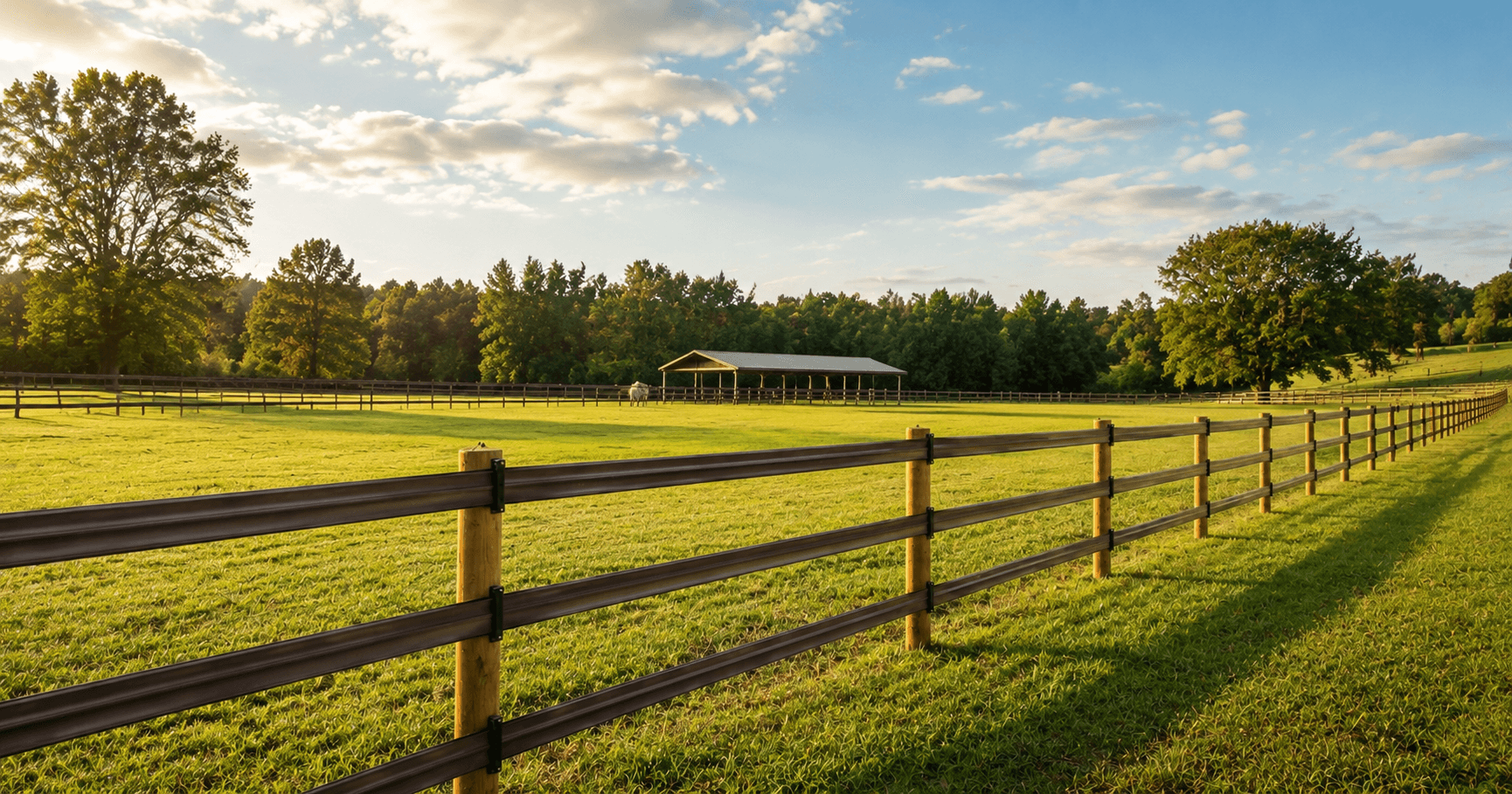
Flexible Rail Horse Fencing: The Complete Guide to Safer, Smarter Equine Enclosures
July 27, 2026 ·
If you own horses, you already know that the paddock is where most preventable injuries happen. A spooked horse crashes into a board fence and splinters fly. A leg tangles in wire. A foal slips under a rail that rotted through last winter. You didn't build your fence to hurt your horses — but traditional materials do exactly that, year after year.
Flexible rail horse fencing was engineered to change that. This guide walks you through everything you need to know: what flexible rail fencing is, why it outperforms wood and wire, and how to choose a system that protects your horses and your investment for decades.
What Is Flexible Rail Horse Fencing?
Flexible rail fencing — sometimes called flex fence or polymer rail fencing — is a horse-specific fencing system built around a wide, UV-stabilised polymer rail that's bonded around high-tensile galvanised steel wire. From a distance, it looks like a classic board fence. Up close, and especially on impact, it behaves nothing like one.
When a horse hits the rail at speed, the polymer flexes and absorbs the shock, then rebounds to its original shape. No splintering. No sharp edges. No exposed wire. The horse bounces off and walks away instead of ending up in the vet clinic.
That single design principle — flex instead of fracture — is why flexible rail has become the fencing of choice for veterinarians, breeders, and professional equestrian facilities across more than 40 countries.
Why Flexible Rail Is the Safest Fence You Can Build
It really does have so many advantages.
It absorbs impact instead of breaking
A rigid wood board has one response to a 1,000-pound animal hitting it at full gallop: it snaps. The break creates jagged edges, and those edges create lacerations. Flexible rail takes the same hit and flexes up to 6–8 inches, cushioning the collision and springing back into position. The rail stays intact. Your horse stays intact.
No splinters, no shards, no entanglement
Wire fencing can wrap around a thrashing leg. PVC cracks into sharp fragments under severe impact. Wood splinters. Flexible rail does none of these things. The smooth polymer surface has no sharp points, and the internal wire is fully enclosed — there's nothing for a hoof or a muzzle to catch on.
High visibility, day and night
Horses don't see fence lines the way you do. A thin wire strand in low light is practically invisible, and that's exactly when collisions happen. Wide polymer rails (4 inches or more) provide a clear, high-contrast boundary that your horses can recognise and respect from any angle, in any lighting. White rail offers maximum contrast against green pasture; brown blends into timber backgrounds; black delivers a bold, modern line on any terrain.
What Sets Migarail Apart
Not all flexible rail is created equal. If you're evaluating systems, here's what distinguishes Migarail Flexible Rail Fencing from the rest of the field.
Integrated graphene electric — no add-ons required
This is where Migarail leaves the competition behind. Most flexible rail systems that offer electrification require a separate conductor wire, standoff insulators at every post, or add-on conductive strips bonded onto the rail surface. Migarail builds the conductor directly into the rail itself: a graphene braid runs along both edges of the entire rail, carrying the current end-to-end. You connect your energiser directly to the graphene braid at the strainer post. No extra wire to buy, no insulators to install, no separate component to maintain. The rail is the fence and the conductor in one piece.
4,200 lbs minimum break strength
Migarail's 4.25-inch (108 mm) rail carries three strands of 12.5-gauge (2.5 mm) high-tensile galvanised wire, delivering a minimum break strength of 4,200 lbs. That's serious holding power — strong enough to contain stallions, draft horses, and foals alike, while still flexible enough to protect them on impact.
Built for extreme climates
Migarail is engineered to perform from −40 °C to +60 °C. Whether you're fencing a property in the freezing Canadian prairies or a sun-baked paddock in the Australian outback, the UV-stabilised PE polymer won't crack in deep freezes, won't soften in extreme heat, and won't fade under relentless sun. The colour you choose on day one is the colour you'll see in year fifteen.
Practically maintenance-free
UV stabilisers are compounded directly into the polymer matrix — not sprayed on as a coating that wears off. The surface won't crack, rot, rust, or splinter. There's no painting, no staining, no board replacement, no mould treatment. A wash with soap and water now and then is all it takes. Compare that to a wood fence that demands repainting every two years and board replacement after every storm.
Installation: You Can Do It Yourself
One of the biggest advantages of flexible rail is that you don't need a specialist crew. Migarail is designed for straightforward, DIY-friendly installation with no special tools. Here's the process in brief:
- Set your posts. Mark post positions at 2.4–3.6 m spacing. Corner and end posts go in concrete at minimum 900 mm depth. All non-straight runs must be braced and concreted to withstand tensioning forces.
- **Let corners cure. **Give concrete a minimum of 48 hours before you start tensioning.
- **Fit rail brackets. **Snap the Rail Brackets (E1) onto line posts at your chosen rail heights. The slip-through design disperses impact, and the polymer coating insulates the rail — no separate insulators needed.
- **Feed the rail. **Thread the rail through the brackets from the end buckle outward. Secure each terminus with a Flex Fence End Buckle (A1/A2).
- **Tension progressively. **Use a Rail Tensioner (B) or Barrel Tensioner (D/F). Start with the top rail, go half-tension, then bring everything to full tension. For runs over 660 ft, use a Two-Way Barrel Tensioner.
- **Connect the energiser. **Attach the energiser lead directly to the graphene braid at the strainer post. The circuit is complete — no separate conductor to run. A typical paddock can be up and fenced in a day, done right the first time.
Choosing Your Configuration
Migarail comes in three colours — White (high contrast, recommended for most properties), Brown (lower visual profile for timber or scrubland), and Black (bold and modern on any terrain) — in 330 ft (100 m) rolls. For most horse properties, a three- or four-rail configuration works well. Stallion paddocks may benefit from four rails with the top rail electrified. For foals, consider a lower bottom rail to prevent rolling under. Your local distributor can help you spec the right layout for your horses and terrain.
The Bottom Line
You have a choice. You can keep repainting boards, replacing broken rails, and hoping your horses don't get hurt. Or you can install a fence that flexes when it matters, carries its own electric, and looks as good in year twenty as it does on day one. Flexible rail fencing isn't just a product — it's a different philosophy. Build the fence once. Trust it for decades. Spend your time with your horses, not your fence.
Frequently Asked Questions
If you understand it properly, you won’t make the wrong choice.
How long does Migarail flexible rail fencing last?
Migarail is engineered for decades of outdoor service. The UV-stabilised PE polymer won't crack, fade, rot, or splinter over its lifespan, and the high-tensile galvanised wire won't stretch or corrode. With proper installation and the occasional tension check, your fence will perform for 20–30+ years — which is why flexible rail carries some of the longest warranties in the fencing industry.
Can I install flexible rail fencing myself, or do I need a contractor?
You can absolutely install it yourself. Migarail requires no special tools, no stripping, crimping, or notching. If you can set posts and follow the tensioning sequence, you can build a professional-grade fence. That said, many owners hire a contractor to drive or set the posts and then handle the rail themselves — a flexible approach that matches whatever skill level and timeline you're working with.
Does the integrated graphene electric really work without a separate wire?
Yes. The graphene braid runs along both edges of the entire rail and carries the electric current end-to-end. You connect your energiser directly to the braid at the strainer post — no standalone conductor wire, no standoff insulators at every post, no separate component to maintain. The rail itself completes the circuit, which means fewer parts, fewer failure points, and a cleaner fence line.
Is flexible rail fencing worth the cost compared to wood or wire?
Upfront, flexible rail sits between wire (cheaper) and quality wood board (comparable). But the real cost of a fence isn't what you pay on day one — it's what you pay over 20 years. No repainting, no board replacement, no vet bills from fence injuries, no wire repairs. Flexible rail pays for itself, and then keeps saving you money for decades after.
Call to action
Build Your Fence System
Talk with our team about your property, your layout, and the right system combination for safer, longer-lasting equine fencing.