
course
How to Build a Safer Horse Paddock: The Complete Guide to Flexible Fencing
July 13, 2026 ·
If you own horses, you already know that your horse paddock is more than just a patch of fenced land. It is where your animals graze, rest, socialize, and recover. It is also where most preventable injuries happen. A poorly designed or aging fence can turn a peaceful pasture into a veterinary emergency in seconds. This guide walks you through everything you need to know about building and maintaining a horse paddock that keeps your animals safe, looks professional, and stands up to years of weather without draining your weekends in repairs.
Why Your Horse Paddock Matters More Than You Think
Paddock injuries are among the most common causes of harm to horses. When a horse bolts, gets spooked, or simply leans against a fence to scratch an itch, the wrong material can cut, splinter, or trap a leg. Traditional timber fencing rots and cracks. Bare high-tensile wire can slice deep into tissue. Barbed wire has no place near horses at all. Yet many properties still rely on these materials simply because they are what was always there.
Your horse paddock deserves better. The fencing you choose directly affects your horses' well-being, your property's appearance, and your long-term maintenance costs. The good news is that engineered flexible fencing has changed the game — giving you a system that absorbs impact instead of transferring it to the animal.
What Makes a Horse Paddock Safe? Five Non-Negotiables
Before you choose a fencing system, you need to understand what separates a safe paddock from a risky one. Here are the five principles that should guide every decision you make:
1. Visibility
Horses need to see their boundaries clearly. A fence that blends into the background is a fence a horse will run into. Wide, high-contrast rails in white or brown give your animals a visual cue that keeps them from testing the perimeter — especially in low light or fog.
2. Impact Absorption
When a horse hits the fence — and eventually, one will — the fence should flex and absorb that energy, not shatter or resist rigidly. Flexible rail fencing bends under pressure and springs back, reducing the force transferred to the horse's body. This is the single biggest safety advantage over timber and rigid wire.
3. No Sharp Edges
Every component in your horse paddock should be smooth and rounded. Coated wire eliminates the cutting risk of bare high-tensile wire. Rails with sealed polymer surfaces will not splinter the way aged wood does. If you can find a sharp edge, a horse will find it too.
4. Structural Strength
Safety does not mean fragility. Your fence needs enough break strength to contain a 1,000-pound animal leaning against it, a fallen tree branch landing on it, or a vehicle clipping it from the roadside. Look for rails rated to at least 4,200 lbs of break strength. ** 5. Weather Endurance
A fence that cracks in the freeze or degrades under UV is not just a maintenance headache — it becomes a safety hazard as it deteriorates. Your horse paddock fencing should be rated for the full temperature range you experience, from deep winter freezes to intense summer sun.
The Problem with Traditional Paddock Fencing
Take an honest walk around your property. If your current horse paddock uses timber, bare wire, or a mix of mismatched materials, you are likely dealing with at least one of these recurring problems:
**Timber posts and rails **rot, warp, and splinter over time. A single cracked rail can gouge a horse's leg, and replacing boards becomes a seasonal chore.
Bare high-tensile wire is strong but nearly invisible to horses in certain lighting. When a horse does contact it, the thin wire can act like a blade.
**Electric tape and braid **are lightweight and visible, but they sag, break in wind, and need constant tensioning. They work as a deterrent, not as a physical barrier.
Mixed systems — where you inherit different fencing on different sides of the property — create weak transitions and inconsistent visibility.
Every one of these issues compounds over time. What starts as a minor maintenance task becomes a safety liability. The longer you wait, the higher the risk that your horse pays the price.
Why Flexible Rail Fencing Is the Modern Standard for Horse Paddocks
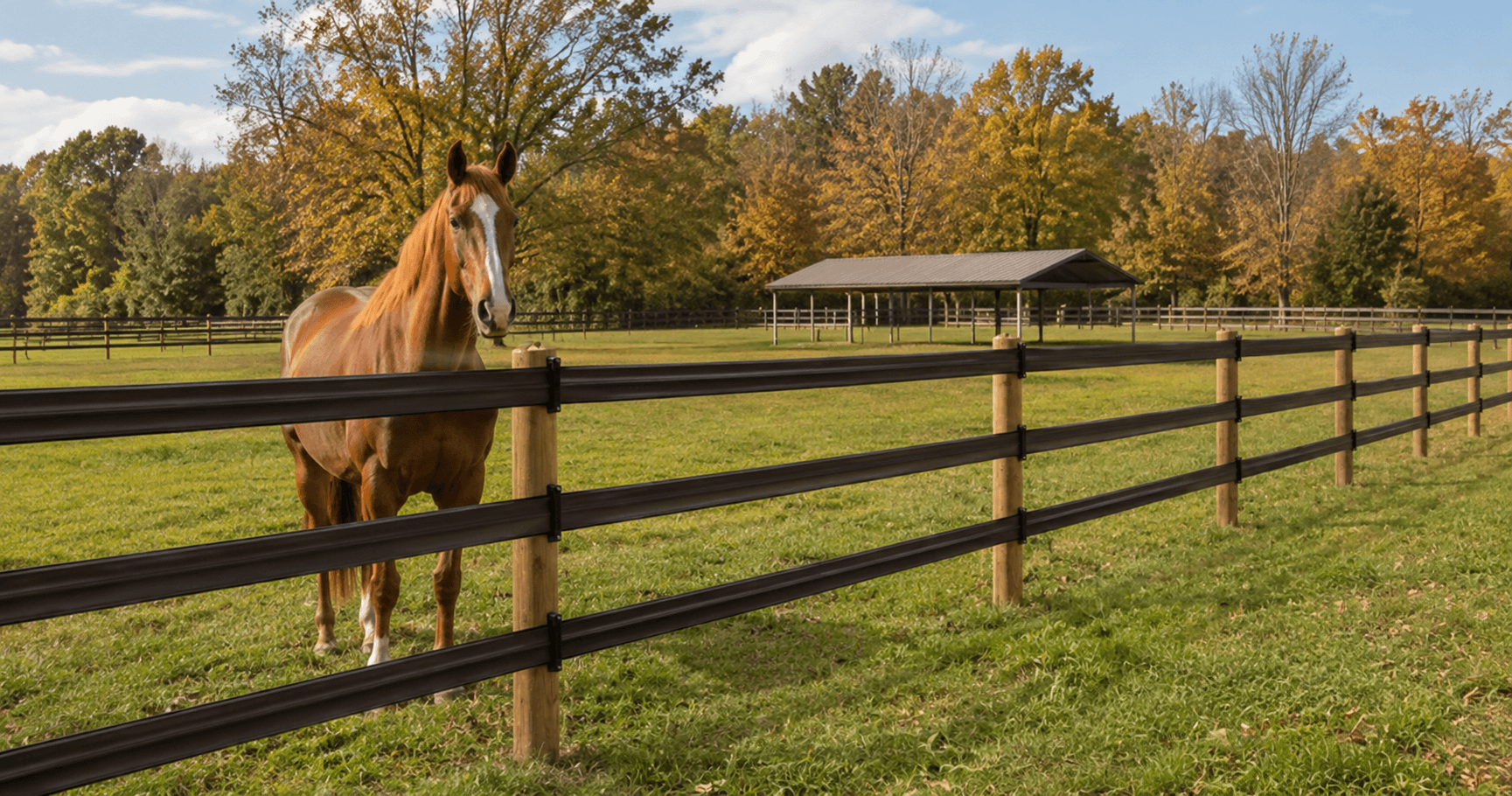
Flexible rail fencing was engineered specifically to solve the problems that traditional materials create. Systems like MigaRail combine a high-tensile steel core with a UV-stabilised polymer coating, giving you the strength of wire and the safety of a smooth, visible rail — all in one product.
Here is what that means for your horse paddock in practice:
**4,200+**lbs break strength per rail -40°C to +60°C operating range 108mmrail width for visibility
The rail absorbs impact instead of splintering. The polymer coating stays colour-fast through years of UV exposure, so your paddock keeps looking clean and professional. The steel core provides structural integrity that tape and braid simply cannot match. And because the system is modular — with compatible coated wire, electric options, and purpose-built accessories — you can design a layout that fits your terrain without compromising on any boundary.
Planning Your Horse Paddock Layout
A safe horse paddock starts with smart planning. Before you install a single post, think through these design factors:
Paddock Size and Shape
Each horse needs adequate grazing space — generally at least one to two acres per animal, depending on climate and pasture quality. Avoid sharp corners where horses can get trapped or cornered by a more dominant herd member. Rounded or rounded-off corners reduce conflict and improve flow. ** Post Spacing and Tension**
Flexible rail systems typically run on wider post spacing than rigid fencing, which reduces your material costs and installation time. However, all corner and end posts must be braced and concreted to handle the tension. This is not optional — it is what keeps your fence standing straight for years.
Gates and Access
Place gates where they make daily routine easier — near the stable, the feed area, and the laneway. A well-placed gate reduces the distance you carry feed and makes moving horses between paddocks safer and less stressful.
Electric Integration
Some flexible rail systems include a conductive layer — such as a graphene conductor — that lets you run electric through the rail itself. This gives you a psychological barrier on top of the physical one, discouraging horses from leaning or testing the fence without adding a separate electric wire.
Installation: Simpler Than You Might Expect
One of the biggest concerns horse owners have is whether they can install a new fencing system themselves. The answer, with a modular flexible rail system, is yes. You do not need specialised tools or a professional crew for standard straight runs.
The process follows a straightforward logic: set your posts, run the rail through bracket systems, tension it, and secure the ends. For corners, end posts, and high-tension sections, you will need bracing and concrete — but this is standard practice for any quality fence, regardless of material.
If your horse paddock sits on uneven terrain, includes a roadside boundary, or requires multiple connected enclosures, a modular system lets you adapt without switching product lines. The rail, coated wire, and accessories all work within the same logic.
Long-Term Maintenance: What to Expect
This is where flexible rail fencing truly separates itself from timber. Once your horse paddock is fenced with a quality flexible system, your ongoing maintenance drops dramatically:
No painting or staining. The polymer coating holds its colour without treatment.
**No splinter repairs. **The rail flexes instead of cracking, so you are not replacing broken boards after storms or impact events.
No rust. The galvanised steel core is protected by the polymer coating, and the coated wire eliminates bare-metal exposure.
Minimal tension adjustment. A properly installed system holds its tension across seasons.
Case studies from horse breeding ranches, thoroughbred spell farms, and private equestrian properties consistently report maintenance cost reductions of 85% or more after switching from timber to flexible rail. That is not a marginal improvement — it is a fundamental shift in how much time and money your paddock demands from you.
Choosing the Right System for Your Horse Paddock
Not all flexible fencing is created equal. When you evaluate options for your horse paddock, look for a system that delivers on all five safety principles simultaneously. MigaRail, for example, is engineered as a coordinated system — flexible rail, coated high-tensile wire, electric capability, and compatible accessories — so every component works together rather than being pieced together from different suppliers.
Available in white, black, and brown, with a 108mm rail width for excellent visibility and a 100-metre roll length that covers serious ground, it is built for properties that take fencing seriously. Whether you are fencing a single residential paddock or a full-scale breeding operation, the system scales to your needs.
Ready to Build a Safer Horse Paddock?
Talk with the MIGA Equine team about your property, your layout, and the right system combination for safer, longer-lasting equine fencing.
Call to action
Build Your Fence System
Talk with our team about your property, your layout, and the right system combination for safer, longer-lasting equine fencing.