
Horse Fencing Guide
Foal-Proof Fencing: How to Design a Fence That Keeps Young Horses Safe
October 12, 2026 · 7 min
A fence that holds a full-grown horse can still fail a foal. Foals don't respect fences the way adult horses do. They roll right next to the fence line and can end up on the other side of it. They wedge tiny hooves into gaps an adult would never fit through. They nurse standing stretched along the rail, they sprint in bursts of energy, and they have no concept of consequences yet.
If you're breeding, foaling out mares, or raising weanlings, your fencing needs a second set of specs on top of the standard ones. This guide covers what changes when there's a foal in the paddock, the numbers that matter, and how a flexible rail system like migaequine MigaRail answers the foal-specific risks.
Why Foals Change the Fence Equation
Foals roll under fences. This is the classic foal fencing failure. A newborn rolls in the grass, works its way toward the fence line, and simply rolls under the bottom rail. It happens fast, and it happens most in the first weeks of life when rolling is constant and coordination is not.
Foal hooves fit where adult hooves don't. A Thoroughbred foal's hoof is small enough to wedge into openings that are harmless to its mother. Mesh that meets adult horse standards can still trap a foal's leg, and a trapped leg plus a panicking mare is one of the worst scenarios on a breeding farm.
Foals play at full speed with no brakes. Weanlings and yearlings run hard, turn late, and collide with things adult horses avoid. The fence has to absorb an impact from an animal that doesn't know how to fall safely yet.
Foals nurse and stretch along the fence. A mare standing near the fence line with a foal nursing beside her puts both animals in close, sustained contact with the rail. Every edge, bolt, and splinter on that rail matters more than it does out in the open field.
The Four Specs That Matter for Foals
Extension services and equine publications agree on the core numbers for foal-proof fencing. Here's what they say.
Bottom rail clearance: no higher than 12 inches. Penn State Extension recommends about 8 inches of clearance at the bottom, enough to keep a hoof from trapping but low enough to stop a foal from rolling under. The common ceiling cited for foal paddocks is 12 inches. Any higher and you're inviting the roll-under.
Rail spacing: 8 to 12 inches between rails. Equus magazine recommends spacing boards 8 to 9 inches apart, close enough to keep a foal in but open enough to avoid head and leg entrapment. Penn State's upper limit is 12 inches between rails. Wider gaps let a foal's head or a playful leg slip through.
Height: at the mare's eye level, usually 5 feet or more. For a 15-hand mare, that's roughly a 5-foot fence. Taller mares and jumping breeds push the number up. The foal won't jump out early in life, but the mare might jump in or out if separated, and a weanling will test the height within months.
Corners: rounded, not square. Square corners let a dominant horse trap a subordinate one, and foals are the lowest-ranking animals in any herd. Rounded corners give a foal an escape route and remove the sharp angle where pileups happen. With tensioned fencing, you can keep square corners structurally and add an internal rail or board across the corner to block access.
Mesh Rules If You Run Wire
If your fencing includes mesh, the foal rules get stricter.
Woven mesh beats welded mesh. Welded joints can break on impact and leave sharp points. Use V-mesh or diamond-mesh woven wire, which flexes and stays intact.
Small openings are the point. Penn State recommends openings either small enough that hooves can't get through (under 3 inches square) or large enough that a trapped leg can pull free. Equus goes further and warns that foals can wedge their feet into 2-by-4-inch non-climb mesh, which is why V-mesh with its tighter diamond pattern is the breeding farm standard.
Smooth wire, high-tensile wire, monofilament, and rubber strip fencing all carry entanglement risk for foals. Equus lists them directly as materials that can tangle a young horse. If you use them anywhere on the property, they don't belong on the mare-and-foal paddock.
Materials That Fail the Foal Test
Barbed wire is out everywhere, but a few adult-approved materials still fail with foals in the mix.
Welded wire fencing breaks at the welds when a foal hits it or a mare leans over it, and broken welds are sharp.
Wide-gap rail systems designed for adult cattle or sport horses can have rail spacing over 12 inches, which passes a foal's head right through.
Rigid pipe fencing has no give. A weanling sprinting into a pipe rail stops dead, and the impact goes straight into its body instead of being absorbed.
Wood, honestly, is a mixed bag for foals. It's visible and familiar, but it splinters, it has nails, and foals chew everything. A foal chewing a treated wood rail is ingesting the treatment along with the wood.
What a Foal-Proof Flexible Rail Looks Like
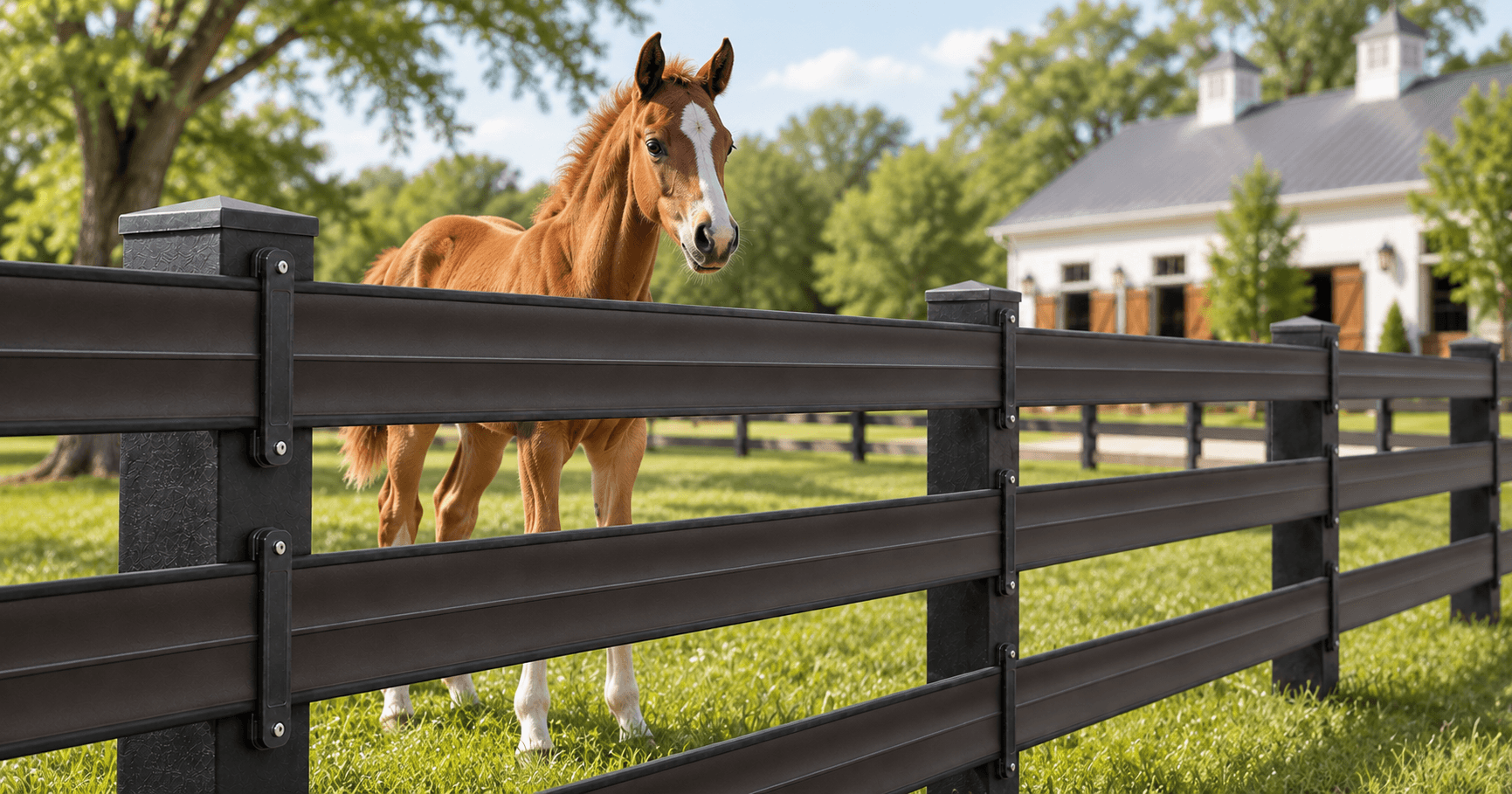
A migaequine MigaRail system addresses the foal specs directly.
The rail surface is polymer, not wood or wire. There are no splinters, no exposed fasteners on the horse side, and nothing for a nursing foal to cut or scrape on. The PE polymer coating over galvanized steel gives you the visibility of a wood rail without the chew damage or the nail heads.
Rail width helps foals see the fence. MigaRail's 108 mm rail face is wide enough for a foal's developing eyes to pick up at a distance. Remember that foals are figuring out depth perception and spatial judgment in their first weeks. A wide white rail is the easiest boundary in the world for them to learn.
The rail flexes on impact and returns to line. A weanling hitting the rail at speed gets slowed and contained, not stopped dead. The 4,200 lb break strength means the rail holds through the collision, and the flex means the foal's body takes far less of the impact force.
You control the rail spacing. A MigaRail install can be configured with tighter rail spacing and a lower bottom rail to hit the 8-to-12-inch foal specs, then the same system serves the adult herd for decades after the foals grow up. You're not building a special foal fence that becomes useless in two years.
Mare-and-Foal Paddock Layout Tips
Give the pair room to move away from herd pressure. Foals need space to get out of the way of dominant horses, and mares with foals get defensive. A paddock that worked for three adult horses might be tight for a mare and foal plus a neighbor.
Double-fence or offset adjacent paddocks. A foal nursing near a shared fence line can get kicked through it by the horse on the other side. If a double fence with a gap isn't in the budget, run an electric offset on the shared line so both sides keep their distance.
Keep the foaling stall and paddock connected. The first turnout after foaling is when the mare patrols the perimeter and the foal follows. A small, strongly fenced paddock attached to the stall lets those first turns happen in a controlled space.
Check the fence before the foal arrives, not after. Walk the line in the last weeks of the pregnancy. Fix the wobbly post and the loose rail now, because you won't have time later and the foal will find whatever you skipped.
Frequently Asked Questions
How high should the bottom rail be for a foal? Between 8 and 12 inches off the ground. Eight inches stops a hoof from trapping under the rail while discouraging grazing under the fence. Twelve inches is the ceiling, and above that a foal can roll under the fence line.
Can a foal see a fence clearly? Foals are born with immature vision and develop full spatial judgment over their first weeks. Wide, high-contrast rails help them learn the boundary faster. White or bright rails against grass are the easiest for a foal to recognize.
Is electric fencing safe for foals? Electric fencing is generally not recommended as the primary containment for mares and newborn foals. A foal that hasn't learned to respect the shock can panic and run through it or tangle in it. If you use electric lines in a foal paddock, pair them with a visible physical rail and introduce them after the foal is mobile and coordinated.
What is the best fence for weanlings? Weanlings need strong, visible, forgiving fencing with tight rail spacing. Flexible rail systems, V-mesh woven wire with a top rail, or closely spaced board fences all work. Avoid rigid pipe, wide-gap rails, and any wire a weanling can tangle in. Weanlings test fences harder than any adult horse.
Call to action
Build Your Fence System
Talk with our team about your property, your layout, and the right system combination for safer, longer-lasting equine fencing.