
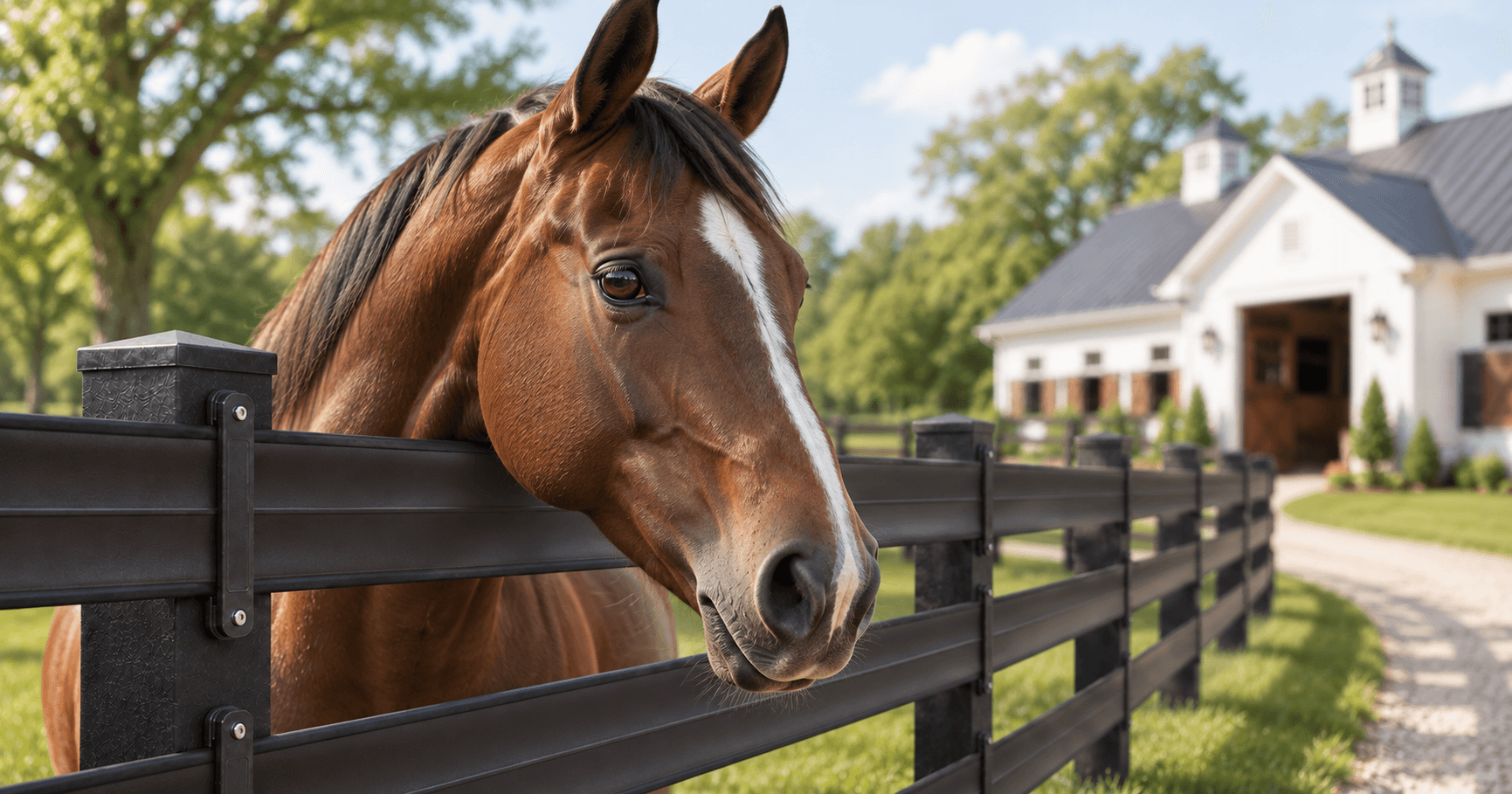
Horse Fencing Guide
Horse Vision and Fence Visibility: Why Your Fence Color Matters More Than You Think
September 16, 2026 · 7 min
When you're choosing a horse fence, you're probably thinking about strength, height, and durability. You're not thinking about how your horse's eyes actually work. But here's the thing: a fence your horse can't see clearly is a fence your horse is more likely to run into, jump awkwardly, or get tangled in. And the research shows that most fences are designed for human eyes, not equine ones.
This guide breaks down how horses see the world, why that matters for your fencing choices, and how a system like migaequine MigaRail is built around visibility from the ground up.
How Horses See the World
Horses are prey animals. Their eyes evolved to spot predators at a distance and react fast. That evolutionary design comes with a few quirks that directly affect how they interact with fences.
Side-set eyes, wide field of view. A horse's eyes sit on the sides of its head, giving it a roughly 350-degree field of vision. That's almost a full circle. But that wide view comes at a cost: horses have a narrow binocular field (about 55 to 65 degrees) directly in front of their nose, and two blind spots. One is directly behind them. The other is directly in front when the head is down grazing.
Dichromatic vision. Horses see color, but not the way you do. Humans have three types of cone cells (trichromatic vision). Horses have two (dichromatic vision). They see blues and yellows well, but reds and oranges appear muted, similar to what a person with red-green color blindness sees. A bright orange fence post that stands out to you might blend into a green pasture background for your horse.
Movement detection over color detail. Horses are wired to notice movement first, shape second, and color third. A solid fence that doesn't move is harder for a horse to track than a fence with some visual texture or motion. That's why strips of cloth or tape on a wire fence help horses learn where the boundary is. Movement catches their eye.
Why Most Fences Are Designed Wrong
Here's the uncomfortable truth: most fence colors are chosen for human aesthetics, not horse visibility.
A study published in Applied Animal Behaviour Science (Paul & Stevens, 2020) analyzed fence markers at 11 UK racecourses using models of horse color vision. The researchers found that orange, the traditional color used on racing fences, has poor visibility and contrast for horses against most natural backgrounds. Yellow, blue, and white were significantly more conspicuous.
When the researchers tested jumping responses, horses adjusted their jump angles and distances based on fence color. White fences produced longer takeoff distances. Fluorescent yellow fences produced shorter landing distances. The horses were responding differently to colors they could actually see.
The British Horseracing Authority took this seriously. They approved trials of fluorescent yellow hurdle frames and guard-rails with white take-off boards. That combination is predicted to maximize visibility across different light and weather conditions.
What this means for your paddock: If elite racehorses are tripping over fences they can't see well, your pasture horses face the same risk. The difference is your fence isn't a controlled obstacle on a maintained course. It's a boundary your horse lives with every day.
The Visibility Problem with Common Fence Materials
Let's look at how different fence types stack up on visibility.
Wood fences. Natural wood (brown, gray, weathered) has decent contrast against green grass but loses visibility against dirt, mud, or dried vegetation. White-painted wood is the gold standard for visibility, which is why traditional horse farms favor it. But white paint needs repainting every 2 to 3 years, and unpainted wood darkens with age.
Wire fences. Thin wire is nearly invisible to horses, especially in low light or against complex backgrounds. High-tensile wire in particular is dangerous because a horse running at full speed may not see it until impact. Adding top rails, flagging tape, or electric offsets helps, but the core visibility problem remains.
Vinyl/PVC fences. White PVC has excellent visibility and doesn't fade as fast as painted wood. But PVC gets brittle in extreme cold and can crack on impact instead of flexing. In northern climates, that brittleness is a safety concern, not just a maintenance one.
Mesh/no-climb wire. The mesh pattern provides some visual texture, which helps horses recognize the boundary. But the thin wire strands still have lower visibility than solid rails, especially at distance.
Electric tape or rope. Wide electric tape (1 to 2 inches) is highly visible because it moves in the wind and often comes in white or bright colors. Thin wire electric fences are less visible and require flagging or additional visual markers.
What Makes a Fence Visible to a Horse
Based on the research and field experience, three factors determine whether a horse can see your fence clearly.
Contrast against the background. A fence that blends into the surrounding landscape is a fence your horse won't see until it's too late. White or bright yellow rails against green grass, dark soil, or snow provide the highest contrast. Brown or gray rails against dried grass or dirt provide the lowest.
Width of the visual element. Horses judge distance and boundaries by visual width. A 4-inch-wide rail is easier to see and judge than a 1-inch wire or a half-inch tape. The wider the visual element, the sooner a horse can identify the boundary and adjust its path.
Height relative to the horse's eye line. A horse with its head up sees the world from about 5 feet off the ground. Fence rails at that height are in the horse's primary visual field. Rails below 2 feet are outside the primary field when the head is up, which is why bottom rails are the hardest for horses to see. That's also why bottom-rail clearance matters so much for safety.
How MigaRail Solves the Visibility Problem
The migaequine MigaRail system was designed with horse visibility in mind, and it shows in three specific ways.
White PE polymer coating. MigaRail's standard color is white, which is the highest-contrast color for equine vision. The PE polymer coating maintains its color through UV exposure without the repainting cycle that white wood demands. The UV stability testing we published earlier showed the coating holds color and integrity through a decade of simulated exposure. That means your fence stays visible year after year, without you reaching for a paint bucket.
108 mm rail width. MigaRail's rails are 108 mm (about 4.25 inches) wide. That width is in the range that horses can easily detect and judge at distance. Compared to thin wire or narrow tape, the wider rail gives your horse a clear visual boundary that it can track even at speed.
Consistent visual line. Because MigaRail maintains tension and doesn't sag or warp like wood, the visual line of the fence stays consistent along the entire perimeter. Horses can learn and remember the boundary because it doesn't change shape over time. A sagging wood fence or a loose wire creates inconsistent visual cues that confuse a horse's spatial judgment.
Designing for Visibility: Practical Tips
Beyond choosing the right fence material, a few design decisions can improve how well your horses see the fence.
Location matters as much as color. Placing a fence at the bottom of a hill, even if that's your property line, creates a visibility problem. Horses galloping toward a downhill fence may not see it until they're on top of it. Placing the fence along the top of a visible ridge gives the horse more time to register the boundary.
Shared fence lines need extra attention. If two groups of horses share a fence line, the social pressure (one horse trying to reach or escape another) can override visibility. A double fence with a gap between the two lines is the safest option, but if that's not practical, a top electric wire adds a psychological barrier that keeps horses back from the physical fence.
Gate visibility is fence visibility. A gate that's the same height and color as the rest of the fence is easier for a horse to process than a gate that looks different. Metal gates in particular can create a visual break that confuses horses. If your gate is metal and your fence is white, consider adding white slats or markers to the gate for visual consistency.
Seasonal changes affect visibility. A fence that's highly visible against green summer grass may blend into brown autumn vegetation or white winter snow. If your property has strong seasonal color shifts, white fencing provides the most consistent visibility year-round.
Frequently Asked Questions
What color fence is best for horses?
White or bright yellow fences provide the highest visibility for horses. Research shows that horses see blues and yellows well but have poor perception of reds and oranges. White fences maintain contrast across most backgrounds and lighting conditions.
Can horses see wire fences?
Thin wire fences are difficult for horses to see, especially at distance or in low light. Horses may run into wire fences at full speed because they don't register the boundary until it's too late. Adding top rails, flagging tape, or wide electric tape improves wire fence visibility.
Why do horses run into fences?
Horses run into fences for several reasons: poor visibility (the horse couldn't see the fence), panic response (the horse was startled and ran without processing its environment), or social pressure (the horse was trying to reach or escape another horse). Fence design plays a major role in preventing all three.
How does fence color affect horse behavior?
Studies show that horses adjust their jumping angles and distances based on fence color. White fences produce longer takeoff distances, suggesting horses process the obstacle differently when they can see it clearly. Orange fences, commonly used in racing, have poor contrast for horse vision and may contribute to awkward jumps or falls.
Wrapping Up
Your horse doesn't see the world the way you do. Its eyes are built for speed, distance, and movement detection. They're not built for picking out a thin wire against a complex background. When you choose a fence, you're choosing what your horse can and can't see at full gallop, at dusk, in rain, and in snow.
A fence that's invisible to your horse is a fence that fails at its primary job. Horse fence visibility isn't an aesthetic choice. It's a safety decision. Choose materials that maximize contrast, width, and consistency. Your horse's eyes will do the rest.
Call to action
Build Your Fence System
Talk with our team about your property, your layout, and the right system combination for safer, longer-lasting equine fencing.