
Horse Fencing Guide
Track System Fencing: How to Build a Paddock Paradise That Actually Works
October 28, 2026 · 8 min
A track system, often called a Paddock Paradise, replaces the open paddock with a loop of fenced lane. Water, hay, and shelter sit at different points on the loop, so your horse walks all day instead of standing at one hay pile. Wild horses cover up to 20 miles a day. Most domestic horses cover a fraction of that, and the gap shows up as obesity, insulin resistance, and laminitis. The track exists to close that gap.
The model comes from Jaime Jackson's book Paddock Paradise; Colorado State University Extension now publishes small-acreage setup guidance. What most guides skip: a track is a fencing project before it's anything else. You're not building one paddock. You're building an inner fence and an outer fence, and those two lines decide whether the system works. Here's the layout logic, the width numbers, and the fencing choices that matter.
Why Horse Owners Are Building Tracks
The logic behind a track system is simple. In an open paddock, horses plant themselves near the food and barely move. In a narrow lane with resources spread around the loop, they have to keep walking to get what they want. Movement is the mechanism, and every design decision either supports it or kills it.
The benefits owners report line up with what the layout is designed to do:
Weight and metabolic control. The track restricts access to lush grass and replaces it with distributed hay stations, which is why track systems are popular for easy keepers and horses with Equine Metabolic Syndrome. The constant walking keeps insulin demand and fat storage in check without strict starvation diets.
Hoof and circulation health. Every step loads and unloads the hoof, acting as a circulatory pump. Varied track surfaces, from pea gravel to hardpack, toughen soles and frogs the way smooth pasture never does.
Fewer stale habits. Horses on tracks have somewhere to go and something to investigate, which cuts down on cribbing, weaving, and fence walking.
Better use of small acreage. Colorado State Extension documents a Golden, Colorado owner whose 7 acres could only support about 17 days of grazing a year. A track system let her keep two horses fit while the interior pasture recovered.
Herd harmony with escape room. Multiple feeding stations spread the herd out instead of crowding everyone around one round bale.
None of this happens if the fencing is wrong. A track that horses bulge through, injure themselves on, or refuse to move along fails at its one job.
The Basic Layout: Two Fences and a Loop
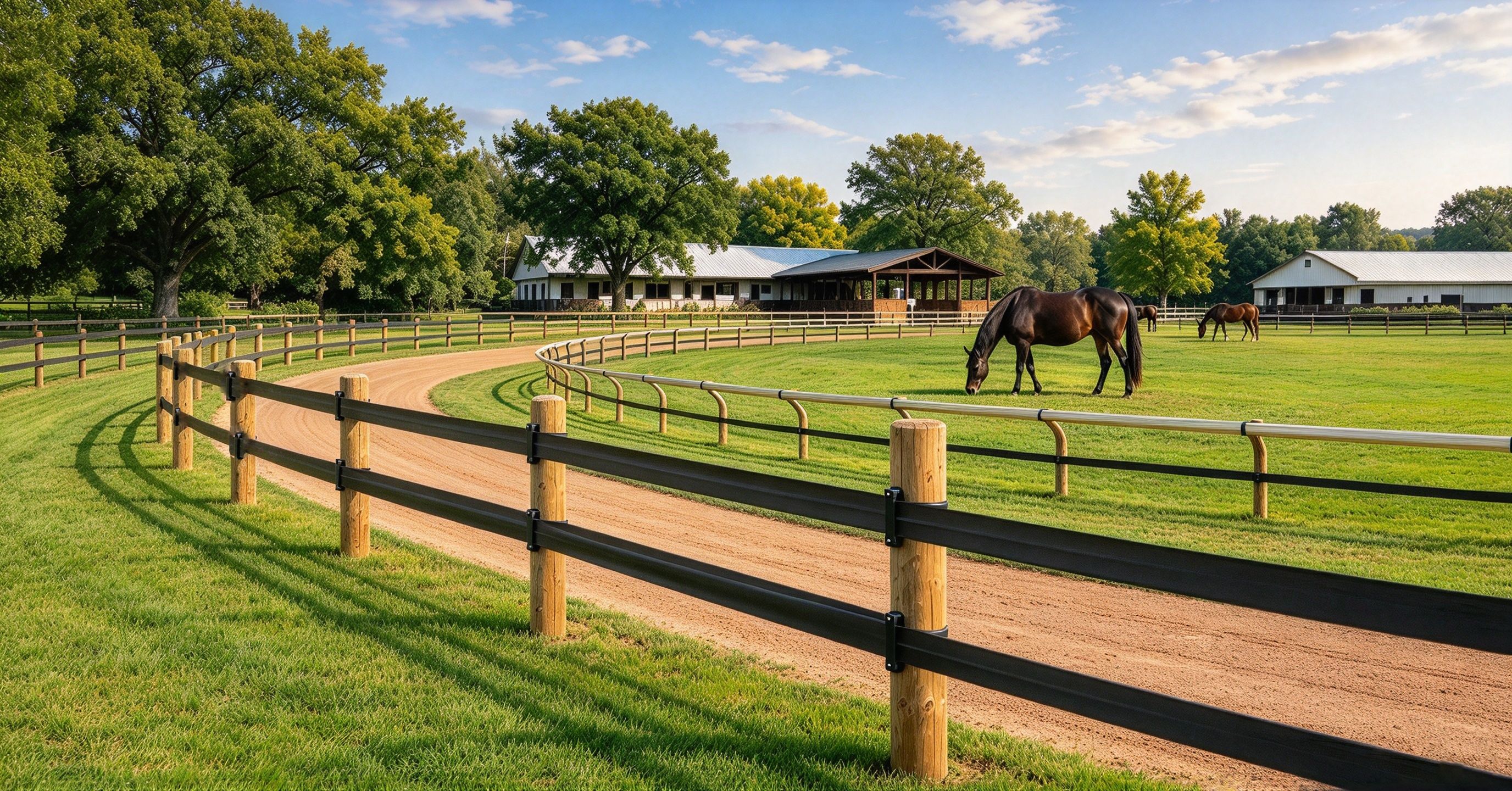
A track system is a lane that runs along the inside perimeter of your existing field, closing back on itself in a loop with no dead ends. The outer fence is usually your existing boundary fence. The inner fence creates the lane, and it's the piece you'll think about most.
Dead ends are the enemy. A loop with an endpoint lets a dominant horse trap a subordinate, and trapped horses in narrow spaces get hurt. Keep the track continuous, and if your property forces a dead end, widen it into a rounded turning area rather than leaving a sharp pocket.
The middle of the loop, now fenced off from the horses, becomes your recovery pasture, a hay field, or a riding space. Some owners open the inner fence for limited grazing when conditions allow, which is another reason the inner fence design matters: it should be something you can gate.
How Wide Should the Track Be?
The most cited working range is 10 to 15 feet, recommended by track system guides and echoed by farm supply sources. For perspective, a standard barn aisle runs about 12 feet, so a horse lane at that width gives two horses room to pass each other without contact.
Going narrower than 10 feet saves fencing footage, but it buys you a behavior problem. Guides from track system operators warn that tight sections let a dominant horse pin a subordinate against the fence. On a track, movement pressure comes from mild confinement, and there's a line between pressure that promotes forward motion and pressure that creates an ambush point.
Going wider slows the system down. A 30-foot lane becomes a thin paddock, and horses settle instead of circulating. Width is your throttle: narrow it where you want flow, widen it where you want rest.
That's the logic behind the standard advice to build two or three lounging bays into the loop, flaring the track out to 50 or 60 feet in spots where horses can lie down, roll, and doze without blocking the lane. A well-designed track alternates: narrow for movement, wide for rest, narrow again.
One honest caveat: width numbers are starting points, not laws. The Colorado State example track runs about 6 feet wide in places because the owner wanted to drive an ATV along it for manure pickup. Her horses adjusted, and the system works for her herd. Start at 10 to 12 feet, watch how your particular herd actually uses the lane, and adjust from there. Which leads to the next point.
Design the Inner Fence to Be Movable
Almost every experienced track owner says the same thing: your first layout will be wrong. The hay station you put at the far end gets ignored. The lounging bay collects manure. The herd bottlenecks at the water trough. You'll want to nudge the lane wider here, pinch it there, and shift station positions.
That's why the standard advice, from Colorado State Extension to long-running track operators, is to build the inner fence from temporary materials first. Polywire or polytape on step-in posts costs little and moves in an afternoon. Run your prototype loop for a full season if you can, through mud and frost and fly season, before you commit to permanent posts.
When you do upgrade, you'll know exactly what you need, and that's when a permanent flexible rail system earns its place on the inner line.
What the Fencing Has to Survive on a Track
Track fencing works harder than paddock fencing, and it's worth being clear about why before you choose materials.
Close-quarters contact. Horses pass each other in a lane that's 10 feet wide. Flank contact, shoulder bumps, and fence-leaning are routine, not exceptional. A rigid fence transfers those loads to posts and fasteners. A flexible rail absorbs them and springs back.
High traffic along the line. Horses walk the loop all day, every day, in all weather. The fence line is not scenery they ignore. It's the edge of their world, and they'll rub on it, sniff it, and test it thousands of times a season.
Visibility at speed. Horses do trot and canter on tracks, especially in play, in a lane narrower than any paddock they've known. A conductor or rail they can see clearly from a distance matters more here than in open field, because there's less room to correct a mistake.
The electric question. Many track operators run their inner fence hot to keep respect high and pressure off the physical barrier. A combined physical-plus-psychological barrier lets you run the inner fence lighter than a pure physical wall would need to be.
Why Flexible Rail Fits a Track System
This is where a system like migaequine's MigaRail matches the track system's demands point for point.
A 108 mm wide white rail reads as a solid wall from anywhere on the loop, which solves the visibility problem in a lane where horses move fast in close quarters. The rail surface is flexible polymer over an integrated graphene conductive layer, so one product gives you both the physical barrier and the electric respect, without stringing separate hot wire alongside a rigid fence. The 4,200 lb break strength takes the shoulder contact and leaning that a narrow lane guarantees. And because the rail flexes and returns, the horse that gets bumped into the fence by a herd mate hits a surface that gives, rather than a board edge or a wire strand.
On a practical build note, a permanent inner fence in a track system runs a lot of footage, often more than the outer boundary, since you're fencing both sides of the loop. Material that holds its tension and shrugs off UV for decades changes how much attention the inner line demands after year two. Track owners with wood board interiors report seasonal board replacement; track owners with polymer rail report checking tension once a year.
The inner fence is also where horses spend their day, so the surface they touch matters. Smooth, gap-free polymer rail has nowhere to catch a hoof, a halter ring, or a tail. That's a quiet benefit until the day it isn't.
You can read the full specifications, including the conductive layer and break strength testing, at migaequine.com/products/flexible-rail.
Stations, Terrain, and the Details That Make It Work
Fencing sets the structure. Stations make it function. The standard layout logic:
Water at one point on the loop, deliberately far from the main forage area, so hydration comes with mileage. Multiple hay stations spaced around the track, using slow feeders or ground piles. Distributing forage is what spreads the herd and keeps traffic moving. Only put out a day's worth at a time while you're tuning the system. Shelter and shade somewhere in the middle of the loop's longer legs, facing the prevailing weather. Varied surfaces where you can manage them: pea gravel at the water trough to toughen frogs, a sand spot for rolling, hardpack on the main travel line, maybe a log or two to step over. Change things occasionally. Operators who rotate obstacles, move a hay station, or open a new lounging bay report horses re-explore the loop instead of settling into a groove. The track is enrichment infrastructure, and novelty is free.
Two rules worth respecting from the track community: keep human activity off the track where possible, so it stays the herd's territory, and pick manure regularly, since a narrow lane concentrates droppings and flies in a way an open paddock doesn't.
FAQ
How much land do you need for a track system? Less than you'd think. The loop runs along your existing perimeter, so the track itself only consumes a strip of your field. Colorado State Extension documents a working system on 7 acres with two horses, and small-acreage owners run tracks on 1 to 2 acres by keeping the lane narrow and relying on hay stations rather than grass.
Can you build a track system with electric fencing alone? Yes, and many owners prototype exactly that way. Temporary polytape on step-in posts lets you test layouts for a season before committing. For the permanent build, most operators pair a substantial outer fence with an inner fence that's either hot itself or backed by a hot strand. The combination of a physical barrier and electric respect is what keeps a narrow lane safe under herd pressure.
How wide should a track system lane be? Start at 10 to 12 feet, the range most track guides recommend. Narrower than about 10 feet risks letting dominant horses trap herd mates against the fence. Wider than 15 feet and horses settle instead of moving. Flare the track out to 50 or 60 feet at two or three points to create lounging bays, then pinch it back down to restore movement.
Do track systems work for laminitic horses? They're one of the main reasons owners build them. A track restricts access to sugary grass while keeping the horse walking, which supports weight control and insulin regulation, both central to laminitis management. The constant movement also promotes hoof circulation. Work with your vet on the forage plan, since a laminitic horse still needs controlled, consistent roughage distributed around the loop.
Call to action
Build Your Fence System
Talk with our team about your property, your layout, and the right system combination for safer, longer-lasting equine fencing.